
· Isha Parikh · Interview ·4 min read
Don’t Skip the Hard Part: A Conversation with Khushbu Patel

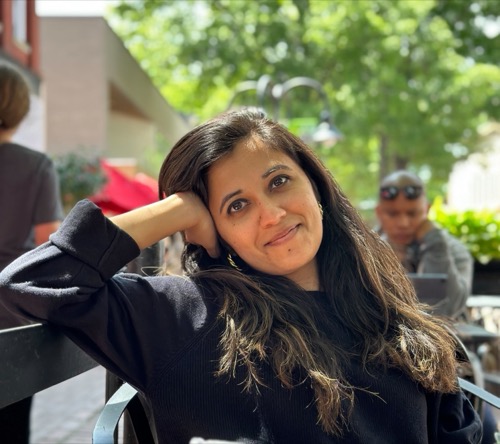
Khushbu Patel is a familiar face in the bioinformatics community, known especially for her YouTube channel, Bioinformagician, where she shares tutorials on bioinformatics concepts and tools. Through her content, she has also become an influential woman in the field helping make bioinformatics more approachable for people learning and building their careers. That visibility is part of what made me want to have a conversation with her.
Khushbu grew up in India without really knowing that bioinformatics was a career. Drawn to both biology and computers, she studied microbiology for her bachelor’s degree while also taking a coding course. Eventually, she discovered that the two worlds could come together and slowly found her way into bioinformatics. Fast-forward more than 10 years, and she has worked across research in pediatric cancer and now helps build harmonized bioinformatics infrastructure and workflows at Children’s Hospital of Philadelphia.
Having found her own way into a field that can feel difficult to navigate from the outside, Khushbu now often hears from students trying to figure out how to do the same. And it is a question both of us get surprisingly often:
I want to get into bioinformatics. What should I learn?
It sounds like a simple question. Except…it isn’t.
A research lab, a core, a clinical center, a nonprofit, a product company, and a service-based organization can all hire bioinformaticians whose jobs look different. Khushbu called it an ever-expanding universe, which feels pretty accurate. Instead of trying to learn all of bioinformatics, she suggests starting with the work that excites you. Look at job descriptions, see what problems those teams are solving, and ask yourself, “Do I want to be part of this?” Once you know the kind of impact you want to have, figuring out what to learn becomes a lot less overwhelming.
And that idea of impact is also what has kept her excited about the field after more than a decade. What fascinates Khushbu most is how bioinformatics brings seemingly different worlds together like statistics, physics, even quantum computing to answer biological questions at different levels. A problem that looks purely biological at first can be approached through computation, modeling and using concepts borrowed from an entirely different field. For her, that is the beauty of bioinformatics: there is rarely just one way to ask a question, and the possibilities keep expanding.
Of course, endless possibilities come with one small problem: endless shiny things to learn…Single cell…Spatial…Multi-omics…AI!
For a lot of early career bioinformaticians, that can quickly turn into a race to keep up with everything new and somewhere in that rush, the basics can get left behind. Because getting something to run and actually understanding what you just ran are two very different things.
That distinction matters even more now that AI has lowered the technical barrier. It can write code, troubleshoot errors, and get a workflow running before you have even finished searching Stack Overflow. But if AI is increasingly helping us with the how, then our role becomes even more about understanding the why.
Why this method? Why this threshold? What happens if I change it? Am I throwing away useful data? Does this result actually make biological sense?
As Khushbu put it:
You only ask why when you know what and how.
That ability to question things comes from fundamentals. For Khushbu, one of the highest-return skills in her career was learning C because it taught her the ABCs of programming and how to think through a computational problem. Tools change. Languages change. The thinking underneath them tends to stay useful.
So, don’t skip the hard part.
Despite more than a decade in the field, she still describes herself as someone who is learning. Bioinformatics is simply too vast for anyone to know all of it. We are all just standing at different points in the same ridiculously long learning curve. And the polished tutorial, LinkedIn post, or YouTube video you are comparing yourself to does not show the fourteen hours, several weekends, failed attempts, and occasional desire to throw the computer out of a window that came before it.
Don’t jump the queue.
Get stuck. Ask the annoying questions. Struggle through the concept. Figure out why something broke. Learn enough to know when your results or your AI assistant are talking nonsense.
Because the uncomfortable part that feels like it is slowing you down is the part where you are actually learning.
The buzzwords, will change!
But curiosity, fundamentals, and knowing how to think through a problem…those are worth holding on to.
Outside the Terminal with Khushbu Patel
A conversation between Isha Parikh and Khushbu Patel.
Isha Parikh asks: Are you ready for a rapid fire? 👀
Khushbu Patel responds: Haha yes...Let’s do it!!
Isha Parikh asks: Early bird or Night owl?
Khushbu Patel responds: Oh, absolutely an early bird ☀️
Isha Parikh asks: On-site, Hybrid or WFH?
Khushbu Patel responds: Team WFH 🙌
Isha Parikh asks: ☕ Coffee or tea?
Khushbu Patel responds: Neither 😅 I’m caffeine-sensitive!
Isha Parikh asks: One bioinformatics tool you cannot live without?
Khushbu Patel responds: Samtools, hands down.
Isha Parikh asks: 💻 Python or R?
Khushbu Patel responds: R, no hesitation.
Isha Parikh asks: 🤖 Claude vs. ChatGPT?
Khushbu Patel responds: Claude!!! 😂
Isha Parikh asks: 🧠 Science fangirl moment?
Khushbu Patel responds: Joshua Starmer, StatQuest 🤓
Isha Parikh asks: Productivity hack?
Khushbu Patel responds: Eat the frog in the morning. Always :)