
· Riya Dua, M.S. · Quick Take ·2 min read · Original Source
AI vs. AI Agents in Healthcare: Not the Same Thing!
The distinction between traditional AI and AI agents is crucial for understanding their impact on healthcare.
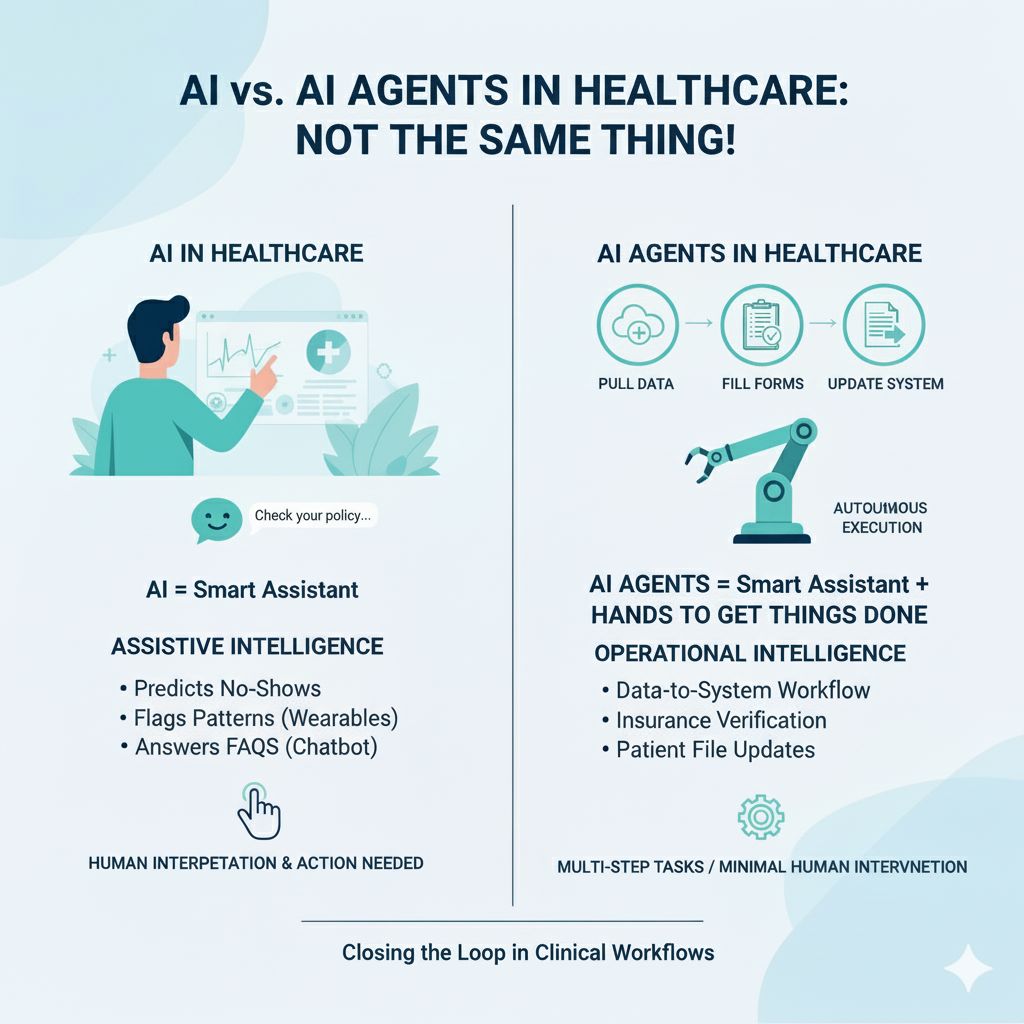
Image Citation: Split graphic by Riya Dua.
Text description of graphic
AI vs. AI Agents in Healthcare: Not the Same Thing!
Left side: AI in healthcare are depicted as assistants providing assistive intelligence. Examples include predicting patient no-shows, flagging patterns from wearables, and answering FAQs via chatbot. Human interpretation and action are still required.
Right side: AI agents are depicted as assistants with “hands to get things done,” providing operational intelligence. Examples include automating data-to-system workflows, insurance verification, and patient file updates. AI agents perform multi-step tasks with minimal human intervention.
Following up on my last post about the growing role of AI Agents in Healthcare, I wanted to draw a sharp distinction: AI vs. AI Agents; they are not the same thing!
Lately, everyone’s been talking about “AI in healthcare” like it’s one big monolithic thing. But honestly, there’s a huge difference between general AI tools and AI agents, and it matters a lot for clinical workflows.
AI in healthcare (in general):
Think of this as assistive intelligence that is usually used for:
Predicting which patients might miss their appointments
Flagging abnormal patterns in wearable data
A chatbot that answers common insurance or billing questions
It’s powerful, but it still depends heavily on clinicians to interpret and act!
AI Agents in healthcare:
These are like the overachievers. They don’t just predict, they operate. Agents take in data, make decisions, and execute multi-step tasks with minimal human intervention.
For example:
An agent can automatically pull data from multiple sources, populate forms, and update the internal system eliminates the need for manual clicks.
A tool can track insurance eligibility, verify coverage, and seamlessly update the patient file in real time.
Basically:
AI = smart assistant
AI Agents = smart assistant + hands to get things done
Why it matters👇🏽
- Healthcare doesn’t just need predictions; it also needs workflows that actually move.
- AI agents can tackle the admin overload that burns out clinicians, while still keeping humans in the loop for real judgment calls.
We’re entering the era where hospitals won’t just ask: “Do we have AI?” They’ll ask: “Do we have agents that can actually close the loop?”
💠 Curious how this evolves in 2026 and beyond clinically, operationally, and ethically!