
· Sharvari Narendra · Interview · 11 min read
Member Spotlight: Aysheh Alrfooh
An interview on methylation, mentorship, and movies
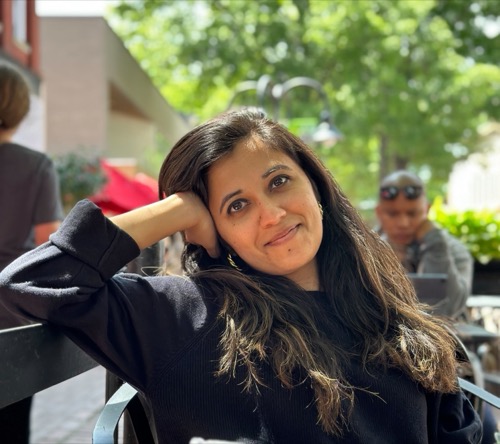
When I first decided to interview Aysheh Alrfooh for the BWiB Member Spotlight, I did what most of us do - I opened her LinkedIn, clicked through her webpage, and tried to piece together a sense of who she was. What I had to go on was this: she co-chairs BWiB’s Career-Sponsorship Committee, and as someone who was selected as a mentor in BWiB’s inaugural mentorship program this year, that alone was enough to pique my curiosity. But by the end of our conversation, I realized that her role at BWiB is just one thread in a much richer story.
Aysheh holds a PhD from the University of Iowa, where her research in epigenetics centered on identifying methylation profiles in individuals with mental health disorders - work that sits at the intersection of computation, biology, and a deeply human question: how do we better understand what’s happening inside the minds of people who are suffering? After her PhD, she completed a Computational Biologist co-op at Biogen before joining Diagonal Therapeutics in Watertown, Massachusetts, where she now works as a Scientist. Diagonal is developing a new class of clustering antibody medicines aimed at addressing the root causes of severe genetic diseases.
There’s a quiet stereotype that follows scientists around, especially the ones who are serious about their craft - that they are one-dimensional, that conversations with them will inevitably loop back to pipelines and p-values. I’ll admit, I walked into this interview half-expecting exactly that, given the breadth of Aysheh’s expertise. But what I’ve learned over the years is that the most accomplished people are usually the most layered. They carry within them whole worlds of curiosity, humor, conviction, and warmth that you don’t see on a CV. Aysheh is one of those people. By the end of our conversation, I wasn’t just impressed by her credentials - I was genuinely charmed by who she is.
Sharvari: First of all, you have such a beautiful name! What does it mean, and how do you pronounce it?
Aysheh: My name comes from an Arabic root (asha) which means ‘to live,’ so my name means ‘alive’ or ‘living,’ which totally describes me as a person, as I am very passionate and I want to live life to the fullest. My name is pronounced in standard Arabic as ‘AA-ee-sha,’ and in a simpler, less formal Arabic it is ‘AH-isha’.
Sharvari: Honestly, that makes the name even more beautiful - there’s something poetic about a name that captures a person so precisely. Thank you for sharing that. Speaking of how you show up in the world - you co-chair the Career-Sponsorship Committee, and BWIB just launched its inaugural mentorship program this year. What drew you to that particular work within the organization?
Aysheh: I think it chose me, not the other way around, haha! I always believe that things find me before I find them, but that doesn’t mean I am depriving myself of free will. I do set intentions for causes I want to pursue, such as women’s empowerment, which has always been on my mind. Just as science empowered me, I want to empower women, and the organization was the perfect fit for that. And of course, when the opportunity appeared, I applied to be co-chair, went through the interview, and got the role. I have been with the organization for over a year now and am entering my second year with them. So grateful for this opportunity.
Sharvari: And speaking as someone on the receiving end of that work - it really is making a difference. The mentorship program has been one of the most valuable learning experiences I’ve had this year, so thank you. On that note, here’s something I personally wrestle with, and I think you’d be the perfect person to ask: if you were mentoring someone brand new to bioinformatics, what’s the very first thing you’d teach them?
Aysheh: Do not be afraid to spend time writing a script from scratch and watching days go by just through learning. The learning phase is supposed to be slow, difficult, and sometimes frustrating, but that is a sign that you are truly growing. Do not be discouraged by a lack of output or low productivity in the early stages of learning. Embrace the process and be patient with yourself.
Sharvari: That’s such grounding advice - and honestly, applicable far beyond bioinformatics. There’s a thread of empathy that runs through everything you say, and I noticed it especially in your PhD work at the University of Iowa. Your research connects molecular biology to mental health - studying DNA methylation in bipolar disorder, schizophrenia, and suicidal behavior. How does the human side of that work shape the way you approach it?
Aysheh: It guided the project to pursue the potential of DNA methylation as a biomarker, in addition to its role as a factor contributing to the risk of suicide. The project targeted DNA methylation sequencing around SNPs that showed an association with suicide attempts in bipolar disorder, and I studied them in blood samples to determine whether we could detect a strong signal that could later be translated into a biomarker.
Sharvari: That’s really powerful work. From there, you moved from epigenetics research in academia at the University of Iowa to your current role as a scientist at Diagonal Therapeutics. Looking back across that arc, what has been your most enriching professional experience so far?
Aysheh: I cannot decide between two different experiences, where one prepared me for the other, and the current one is preparing me for future opportunities. A PhD is a very individualistic experience whose main focus is learning how to pursue a research question and answer it scientifically, while also developing analytical thinking. Your first job after a PhD is where you apply what you learned, adjusting it to suit the fast pace of a corporate environment. My PhD prepared me for my current job, and my current job is preparing me for future opportunities.
Sharvari: I love that framing - every chapter doing the quiet work of setting up the next one. Sticking with that transition for a moment: you made the leap from an academic PhD lab to industry. What surprised you most about that shift?
Aysheh: Finding something interesting is not enough on its own - the real question is whether it has a practical application. That said, I have a deep love for science, and I sometimes appreciate it from a more artistic perspective, finding beauty in a discovery simply because it is fascinating. But in industry, curiosity alone is not enough; there has to be a clear path to real-world impact.
Sharvari: That tension between science as art and science as application is such a real one. Thank you for naming it so honestly. On the topic of paths and turning points - is there a moment in your career where you thought, “If I had chosen this other path, things could have been different”? How has that shaped where you are now?
Aysheh: Life has given me so many interesting and challenging options. One moment that stands out, among many, is when I got accepted into dental school to pursue a dentistry career but chose to study pharmacy instead. After graduation, I worked in a community pharmacy for one month, and on my second day I handed in my notice. And absolutely no regret!!
I believe we—most of the time—have a choice, but I realized that what matters more than the choice itself is how you deal with the unexpected. You can think about your choices a lot, study them carefully, and do your research, but if you are not ready for the unexpected by having resilience and flexibility, you will not be ready for life. Choice is a fun game, but it is not enough on its own.
That said, I recognize this is a very privileged perspective. Not everyone has the luxury of choice, and in many parts of the world people are simply fighting to survive.
Sharvari: “If you are not ready for the unexpected by having resilience and flexibility, you will not be ready for life” - I might be quoting that one back to myself for a long time. Speaking of being ready for the unexpected, AI is reshaping bioinformatics rapidly. How is it changing your day-to-day work, and what should newcomers to the field understand about that shift?
Aysheh: It is changing the field a lot, just as it is changing the whole world, and there is a lot of fear as well as excitement as the AI industry is currently navigating the ‘Peak of Inflated Expectations’ and beginning its descent into the ‘Trough of Disillusionment’ of the hype cycle. In my day to day, it is increasing my productivity by giving me faster access to answers, such as fixing a bug in my script, so the expectations are now higher for delivering more in a shorter time.
For newcomers, I would say: keep yourself updated with all the new AI tools and their latest versions that best suit and serve your role. Always double check the scripts written with AI and the outcomes generated by AI, and make sure you truly understand them. It is also worth learning about Agentic AI. Finally, work on your communication skills, because the shift in bioinformatics will place us at the interface between AI, research, and biology groups.
Sharvari: A measured and very practical take - I appreciate that you neither hype it nor dismiss it. Now, if AI is buying us back some time, here’s a fun question: if you had all the time and resources in the world, what bioinformatics project would you work on?
Aysheh: It would be a project in aging research, and I will be returning to DNA methylation, but this time with a more integrated approach. DNA methylation is my first love in science, and as they say, it is very difficult to forget your first love!!
Sharvari: I’ll definitely be keeping an eye out for your work - “DNA meth-aysheh-lation”, if you will. Here’s one I’ve been excited to ask: if you ran into the 10-year-younger and the 10-year-older version of yourself, and you could only say one thing to each of them - what would it be?
Aysheh: The advice I would give my younger self is: trust the process and just keep going. I always used to put in more effort than necessary, worrying about what might go wrong and fearing I would regret not trying hard enough, which kept me in a cycle of unnecessary stress. Stress is inevitable in adult life, but it is not something young people should have to carry. I wish I had enjoyed my school years more. As for my older self, I cannot wait to meet you, and things will be great and even more exciting. It is only upward from here in every aspect, because we are ready.
Sharvari: That message to your older self genuinely gave me goosebumps. I have a feeling both versions of you would be deeply proud of who you are right now - not just for what you’ve achieved, but for how you’ve grown into yourself along the way. As someone juggling a lot of responsibilities, what’s the best way for you to unwind after a tough day?
Aysheh: On a warm sunny day, I would love to go for a walk and watch the sunset. On a rainy or cold day, I would prefer staying in and watching TV. I actually have a spreadsheet of all the movies I have watched along with my ratings, if you are interested!
Sharvari: Oh, consider me very interested - I’ll be following up on that. If someone could also generate a spreadsheet of all the bioinformatics tools along with their ratings, I would also be interested in that, haha..! Before we wrap, one last thing - let’s play a game. Tell me two truths and a lie about yourself, and we’ll leave our readers to guess which is which.
Aysheh: I completed the Everest Base Camp trek, I have 6.2 million views on my Google Maps photos, and I have 10 siblings.
Sharvari: I have my guess. Readers, I’ll let you form yours. Aysheh, thank you so much for this conversation, for the openness you brought to every question, and for the wisdom tucked into all of your answers. I hope I get the chance to talk to your 10 year older self in the future for another interview!