
· Dana Moochnick · Interview · 7 min read
Member Spotlight: Sharvari Narendra
Finding Her Voice, One Pipeline at a Time
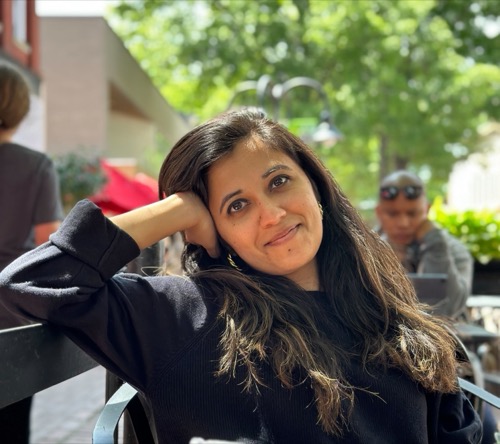
From the outside, Sharvari Narendra seems like someone who has it all figured out. As a host of A Coffee with Comp Bio Season 2 Podcast, she speaks with confidence and ease, clearly grounded in her work in bioinformatics. It’s the kind of presence that makes you assume the path behind her mastery was just as steady. So when I sat down to interview her about her career journey, I expected a straightforward story. I was wrong, and I left the conversation genuinely inspired.
When Sharvari completed her Master’s in Microbiology in India, she was already on a seemingly strong, stable career path. However, stepping into an entry job, doing work that made sense on paper, she very quickly realized something important. It wasn’t the work she wanted to be doing.
She had pivoted to what she calls a “dry lab”, but not in the way we think of it now. It wasn’t biological data analysis. It was simply sitting behind a computer, doing work that didn’t feel connected to anything she cared about. She knew it wasn’t her calling, but like many people in that position, she didn’t have a clear reason to leave yet. That push came from somewhere unexpected.
In 2017, Sharvari was selected to attend the Harvard College Project for Asian and International Relations (HPAIR), an experience that would quietly change the course of her life. This global conference brings together students and young professionals to discuss major economic, political, and social issues across the Asia-Pacific region. It’s a space for future leaders, people thinking broadly about the world and their place in it. For Sharvari, it was also her first time traveling to the United States, and her first time traveling alone. She arrived in snowy Boston in the middle of winter, stepping into the cold, the unknown, and a completely new world all at once. And something shifted. It wasn’t just the setting. It was the people. The conversations. The energy in the room. As she put it, “It wasn’t the HPAIR conference per se that captured my interest, it was the attendees. They were from so many different walks of life, but all of them had one thing in common. They were all passionate about something in their lives. I wanted that.”
That moment had nothing to do with bioinformatics. It had everything to do with perspective. For the first time, she wasn’t just thinking about finding a stable job. She was thinking about what it would mean to care deeply about the work she was doing. That realization gave Sharvari the courage to make a difficult decision. When she returned to India, she left her job. Not because she had a perfect plan waiting, but because she was finally ready to search for something that felt right. What followed wasn’t a clean transition. It was a period of exploration. She tried workshops in science communication, pursued language certifications, and even considered going back into academia for a PhD in Molecular Biology. Each step didn’t necessarily bring her closer to a clear answer, but it helped her understand what didn’t fit, which turned out to be just as important.
Then she came across a 10-day workshop in bioinformatics and metagenomics. “That one stuck with me,” she reflected. This time, the interest felt different. It wasn’t entirely new, she had been introduced to bioinformatics during her microbiology training, but now she was seeing its potential up close. The idea that you could use a computer to understand complex biological systems, like the gut microbiome, opened up a completely new way of thinking. That curiosity turned into a decision. She applied to Northeastern University’s Master’s program in Bioinformatics and returned to Boston, this time with purpose. Same city, but a completely different chapter.
For Sharvari, choosing the “right” path didn’t suddenly make things easy. She explained, “I found out how much I did not know. Many times I wondered if I had done the right thing coming all the way from India.” Coding wasn’t intuitive at first. The coursework was demanding. The job search felt unpredictable. And layered on top of it all was the weight of being far from home, navigating a system that didn’t always feel built for you. It’s the kind of stretch where confidence comes and goes, sometimes hourly.
She had been looking for a sign. Fortunately, it showed up as an opportunity.
During her internship at McLean Hospital, Sharvari worked with RNA-seq data, studying how alcohol affects gene expression in the brain. For the first time, the abstract became tangible. This wasn’t just theory anymore. It was an application. “This internship reminded me why I had chosen bioinformatics. The passion to solve biological problems using a computer.” And just like that, things didn’t feel perfect, but they felt right enough to keep going.
Today, Sharvari works as a Bioinformatics Analyst at the University of Virginia, focusing on microbial genomics. Which, if you take out the technical language, means she spends her time using data to understand how microbes behave, spread, and evolve. From bacterial genomes to wastewater surveillance, her work sits at the intersection of computation and real-world impact. When she talks about it, Sharvari feels less uncertainty as she perseveres in the field, and more curiosity, “the revolution that next generation sequencing has brought to microbiology cannot be understated.” Sharvari shares as she lights up talking about how we can now track infectious diseases, identify resistance genes, and even trace the origins of microbes across time. It’s complex work, but her excitement makes it feel accessible.
Her technical experience is impressive, but what stood out most in our conversation wasn’t just the science. It was how she talked about her journey of growth. When I asked about challenges, she didn’t mention coding or technical obstacles. She said one word: agency, “I will give my opinion and if someone disagrees, I don’t really push for my opinion.” It’s the kind of thing many people experience, especially early in their careers, but rarely say out loud. Learning how to take up space, how to stand behind your ideas, how to engage instead of stepping back. These aren’t things you pick up from a textbook. They come with time, and practice, and a willingness to be uncomfortable. It’s something she’s actively working on, by stepping into leadership roles and taking ownership of her work, even when it would be easier not to.
When the conversation shifted to AI, her answer felt refreshingly balanced, “It’s so scary and so incredible all at once” Sharvari admitted. She doesn’t see it as something that replaces bioinformaticians, but something that raises the bar. Less time spent on repetitive coding, more time spent actually thinking about the biology behind the data. In a way, it’s pushing the field closer to what it was always meant to be.
Outside of her technical work, Sharvari also serves as co-chair of the Boston Women in Bioinformatics podcast. And here, her perspective becomes even clearer, “What makes a scientific conversation truly impactful is if it can reach the layman in the way it was intended.” Science isn’t meant to feel exclusive. It’s meant to be understood. And she’s intentional about creating conversations that feel accessible, not intimidating.
Toward the end of our conversation, I asked her what she would say to someone who feels curious about bioinformatics but also hesitant to step into it. Her answer had nothing to do with technical skills, “the intimidation comes from the fear of failing at something new.” And then she reframed it saying, “who is going to care if I fail? Nobody who truly cares about you is going to judge you.” It’s a perspective that feels obvious once you hear it, and surprisingly hard to internalize before you take it into action for yourself.
Last month Sharvari moderated a fantastic webinar on The Perfect Predator, a story rooted in infectious disease and real-world impact. It fits naturally into the work she’s already doing, connecting science, storytelling, and community. Check it out at this link: https://www.youtube.com/watch?v=-xvSOig0VMg&t=2901s
Looking back, her journey reads like a series of decisions made with just enough clarity to take the next step. Leaving a job. Trying something new. Moving across the world. Staying when it got hard.
And somewhere along the way, without forcing it, she built something meaningful. Not all at once. Not perfectly.
Just one step, and one pipeline, at a time.